
The idea of planning a Jamaica Tour is exciting. The beaches are gorgeous. The music is loud. Food is delicious. People are friendly and warm. However, before packing your bags, there’s one thing you need to be aware of. Jamaican language, Jamaica is different from traditional English.
Indeed, English is officially the language in Jamaica. However, most Jamaicans use Jamaican Patois in daily life. It’s quick, lively, and full of culture. If you know some common short phrases and slang phrases, your Jamaica Tour will be smoother and more enjoyable.
In this article, you will learn the most common Jamaican expressions as well as their meanings and the appropriate times you should make use of the words. Also, you will learn how the Jamaican language works and why it’s important to travelers.
Why Learning Local Slang Matters on a Jamaica Tour
Each year, millions of tourists travel to Jamaica. As per the Jamaica Tourist Board, the nation welcomes more than 3 million visitors each year who stop over, and the tourism industry is responsible for over 30% to the country’s GDP. This highlights how crucial tourism is for the country.
If you are traveling to an unfamiliar location, knowing some local words can help build a connection. It displays respect. It brings people to smile. When you’re on your Jamaica Tour, even saying a few local words can alter the way people feel about you.
Jamaican Patois isn’t broken English. This is an indigenous creole dialect that has origins in English, West African languages, Spanish, and French. It was developed during the colonial period and has become a significant element of Jamaican identity.
Knowing the Jamaican language will help you when you need to use taxis, markets, and restaurants, and even in your hotel.
Basic Greetings You Should Know
If you arrive in Jamaica, the first thing you’ll listen to the word “Wah Gwaan?”
“Wah Gwaan” means “What’s going on?” or “How are you?” It’s a greeting that is friendly. You can reply to the greeting with “Mi deh yah,” which is “I am here” or “I’m good.”
A different greeting that is commonly used. Another common greeting is “Bless up.” This is a positive way to say goodbye or hello. It is a positive way to express your gratitude.
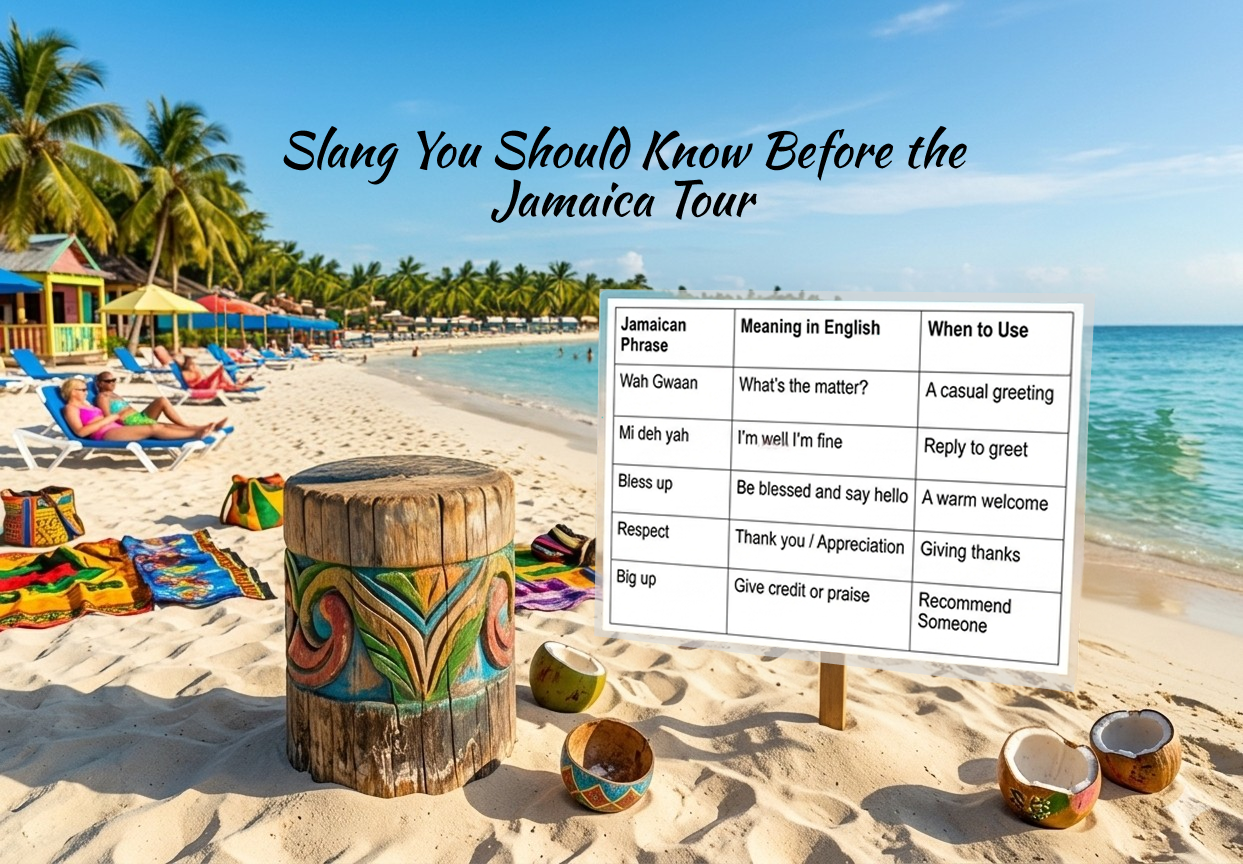
Here’s a table to help you comprehend commonly used greetings in Jamaica.
| Jamaican Phrase | Meaning in English | When to Use |
| Wah Gwaan | What’s the matter? | A casual greeting |
| Mi deh yah | I’m well I’m fine | Reply to greet |
| Bless up | Be blessed and say hello | A warm welcome |
| Respect | Thank you / Appreciation | Giving thanks |
| Big up | Give credit or praise | Recommend Someone |
When you are on the day of your Jamaica Tour, using these phrases will make locals satisfied. They will notice that you’re trying to make connections.
Everyday Short Sentences in Jamaica Language
In everyday routine, Jamaicans employ simple and short sentences. They speak fast, but clearly.
“Mi soon come” means “I will be back soon.” Be careful. For Jamaica, “soon” does not always mean immediately. It may take a while. Take a break and relax. life.
“Mi hungry” means “I am hungry.”
“Mi tired” means “I am tired.”
“Mi love it” means “I love it.”
Take note of Something. They frequently make use of “Mi” instead of “I.”
Here’s another table to help you.
| Standard English | Jamaican Patois |
| I am happy | Mi happy |
| I’m not sure. | Mi nuh knows |
| Where are you planning to go? | A weh yuh go? |
| Welcome to the site | Come yah |
| Let’s go | Mek wi go |
These phrases can be useful when you are on the course of your Jamaica Tour when you talk to shop owners, drivers, or beach sellers.
Popular Jamaican Slang You Will Hear
The Jamaican language is lively and enjoyable. It frequently connects with the arts and cultures, particularly dancehall and reggae.
“Irie” means everything is positive. It is a feeling of being happy and optimistic.
“No problem” is often described in the form of “No problem, man.” It is a reflection of the laidback island lifestyle.
“Ya mon” or “Yah man” signifies” yes. It indicates agreement.
“Gyal” means girl.
“Bredren” means brother or close friend.
“Pickney” means child.
These phrases are commonly used during these phrases are commonplace during a Jamaica Tour, especially in the tourist-filled areas of Montego Bay, Ocho Rios, and Negril.
You can hear music being played. There are songs by Bob Marley. His music was instrumental in spreading Jamaican tradition and culture across the globe. Songs such as “One Love” and “Three Little Birds” helped make Jamaican slang a hit worldwide.
Slang Used in Food and Restaurants
Food is an integral component of any Jamaica Tour. Jamaican food is rich and spicy. There are special phrases in restaurants.
“Jerk” refers to a method of cooking using smoke and spices. Jerk chicken is famous worldwide.
“Patty” means a Jamaican meat pie. It’s spicy and delicious.
If someone tells you “Di food tun up,” it means that the food tastes fantastic.
Here are some food-related phrases in paragraph form to help you can understand how they’re employed. If you hear a local say “Dis nice bad,” they are saying that the food was extremely good. If they declare “Mi belly full,” this means they’re satisfied after eating.
Achieving local food like saltfish, ackee, curry goat, and festival bread can complete the Jamaica Tour.
Negotiation Tips and Street Bargaining During Your Jamaica Tour
When you embark on a Jamaica Tour, you will visit local markets, craft stores, and beach sellers. In a lot of these locations, prices aren’t always set. So, it is commonplace to negotiate. It’s part of the cultural norm, particularly in tourist areas such as Montego Bay and Ocho Rios.
Be calm and respectful. Jamaicans are confident; however, they don’t appreciate rude behaviour. Always smile. Begin by asking “How much fi dis?” that is “How much is this?” The seller could offer an initial price that is higher. This is common in tourist destinations.
It is possible to reply with, “Dat likkle high, can yuh do betta?” This signifies, “That is a bit high, can you give a better price?” Be friendly. Negotiating with the people of Jamaica is more of an exchange of words than a battle.
The research on tourism indicates that shopping and local craft rank among the top 5 things to do for tourists visiting Jamaica. A lot of tourists purchase handmade products such as paintings and souvenirs. This is why vendors are likely to bargain during a Jamaica Tour.
If you’d like to make a concession on price, make it so respectfully. For instance, you could declare, “Mi have $20, dat mi budget.” This is essentially saying that you have $20 as your price limit. Sometimes, the seller will be willing to accept. However, sometimes they won’t. If the offer does not meet your needs It is acceptable to tell the vendor, “Respect, mi will think bout it,” and then walk away. Often, the seller might call back with an offer that is better.
Do not bargain in large eateries or stores. The prices are set. Negotiation is generally restricted to street markets, taxis that do not have meters, and beach vendors.
When you are on the course of your Jamaica Tour, negotiation should be pleasant and easy. It’s an integral part of the Jamaican enjoyment. Be relaxed, talk kindly, and enjoy the conversation. In Jamaica, positive vibes usually bring you good rates.
Taxi and Street Conversation Slang
If you travel across Jamaica, it is common to speak to taxi drivers and street vendors.
If someone says “Weh yuh deh pon?” they’re looking for where you’re staying.
When you hear “Dat far,” it signifies that the location is far away.
“Link up” means meet up.
Price discussions can be quick and easy. Always be sure to ask for a clear price and confirm the price prior to the ride beginning.
Statistics on tourism show the majority of tourists venture out from their resorts on the Jamaica Tour. That means that you’ll encounter locals on a regular basis. A basic understanding of slang will give you confidence.
Cultural Expressions You Should Respect
Jamaica is a country with strong cultural roots. Rastafarian culture is significant. It is possible to hear “Jah,” which refers to God in the Rastafarian faith.
“Give thanks” means thank God for his blessings. God.
“Livity” means lifestyle, especially a spiritual approach to living.
Respect is an important aspect of Jamaican culture. The practice of saying “Respect” instead of thank you is a common practice.
Knowing these expressions will show an understanding of the culture on the course of your Jamaica Tour.
The Role of Music in Jamaica Language
Music plays a significant role in the shaping of Jamaican slang. Dancehall and reggae music have an impact on the daily language.
Musicians like Sean Paul and Shaggy use Patois in their music. This has made the Jamaica Language become global.
If you are at an event at the beach or a club night on the course of your Jamaica Tour, you will listen to fast-paced lyrics and fun phrases. Even if you don’t comprehend each word, you’ll feel the beat.
Is Jamaican Patois Hard to Understand?
It may at first seem complicated. But don’t worry. The majority of Jamaicans are able to switch to normal English when talking to foreigners.
In reality, Jamaica has one of the highest literacy rates in the Caribbean, more than 88 percent. English is widely used in both schools and other official places. This means that when you go on the course of your Jamaica Tour, communication will not be an issue.
However, knowing 10 to 15 phrases that are commonly used will help you improve your life substantially.
Where to Stay During Your Jamaica Tour
The choice of the best location for your stay is crucial. Security, comfort, and location are crucial.
If you’re planning a luxurious and tranquil vacation, Northritz Villa is the best option. It is the ideal location where you can stay while in Jamaica since it provides peace, privacy, luxury, as well as ocean views, along with the best service. The villa offers peace away from the crowded hotels. Many people prefer this Villa in Jamaica for family vacations and romantic getaways. Its location is perfect to explore beaches and other places to visit while taking in the peaceful night.
When you go on the course of your Jamaica Tour, staying at Northritz Villa will make your journey more memorable.
Simple Conversation Example for Your Jamaica Tour
Let’s imagine a brief conversation.
Local: Wah Gwaan?
You: Mi deh yah.
Local: Weh yuh deh pon?
You: I’m staying in a Northritz Villa.
Local: Oh, nice! Big up!
The effort of a few minutes can result in smiles and positive vibes.
Travel Tips for Better Communication
Talk slowly and pay attention. Smile frequently. Jamaicans are friendly and welcoming. If you don’t understand something, you can ask them to repeat it.
Beware of copying slang phrases mockingly. Be respectful and use it in a manner that is natural.
It is important to remember that tone is crucial. Jamaican Patois is musical and expressive.
Final Thoughts Before Your Jamaica Tour
A Jamaica Tour is more than sunshine and beaches. It’s about culture, food, music, and also the language. The ability to understand common short sentences as well as Slang will make your visit more enjoyable.
You’ll be able to connect with people in your area. You will be able to understand conversations happening about you. You’ll feel more comfortable going to the beach, markets, and cities.
It is believed that the Jamaican language is part of Jamaica’s core. It is a symbol of identity and history. Just a few words, such as “Wah Gwaan” and “Respect,” can alter your experience of traveling.
Before you embark on you go on your Jamaica Tour, take time to master these simple phrases. Bring your suitcases. Make yourself ready for the sun. When you get there, you can smile and say “Bless up!”
Frequently Asked Questions About Jamaica Tour and Jamaica Language
1. Is English used on the Jamaica Tour?
Yes. English is considered to be the primary language in Jamaica. The majority of Jamaicans can speak English proficiently. But most locals prefer Jamaican Patois in daily conversations.
2. Are Jamaican Patois a real language?
Yes. Jamaican Patois is a recognized creole language that has its own distinct syntax and grammar. It was derived by combining English and African languages.
3. Do I have to study Jamaica Language before visiting?
It’s not necessary, however, but knowing some basic phrases could enhance the quality of your Jamaica Tour experience and help you make connections with the Jamaicans.
4. What does “Wah Gwaan” mean?
“Wah Gwaan” means “What’s going on?” or “How are you?” It’s a popular salutation in Jamaica.
5. What should I do during my Jamaica Tour?
If you are looking for privacy, comfort and luxury, Northritz Villa is one of the top alternatives. It is a tranquil retreat and is easy to access important tourist attractions.
